
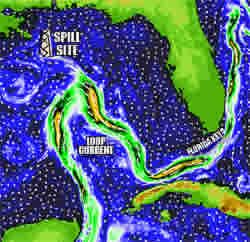
Graphic detailing the Gulf spill site and the loop current. Base graphic courtesy oilspill.fsu.edu.
U.S. Coast Guard Key West Sector Captain Pat DeQuattro confirmed Wednesday morning that tests on tar balls found Monday and Tuesday on Key West's Fort Zachary Taylor State Park beach and other areas of the Lower Keys are not from the Transocean/BP oil spill in the northern Gulf of Mexico.
"The results of those tests conclusively show that the tar balls collected from Florida Keys beaches do not match the type of oil from the Deepwater Horizon oil spill in the Gulf of Mexico," according to a Coast Guard-issued news release. "The source of the tar balls remains unknown at this time."
A sampling of tar balls discovered on beaches at Fort Zachary Taylor State Park, Smathers Beach in Key West, Big Pine Key, Fla., and Loggerhead Key in the Dry Tortugas National Park, Fla. were flown by a Coast Guard HU-25 Falcon jet based in Miami to New London, Conn., Tuesday for testing and analysis.
On Tuesday, much of the media reporting concluded that the tar balls were from the Gulf oil spill, despite the fact that the Coast Guard had not confirmed their source.
It is not unusual to find tar balls in Keys waters or on area beaches. The Keys are located along a busy commercial shipping route, with some 8,000 vessels passing by annually, and commercial vessels sometimes discharge bilge water that contains oil. Tar balls can drift into Keys waters from other areas, not just the northern Gulf region.
Meanwhile, as of late Tuesday satellite imagery indicated the bulk of the oil remains dozens of miles away from the Loop Current, but a tendril of light oil appears to have been transported within close proximity to the current. The National Oceanic and Atmospheric Administration is conducting aerial observations to ascertain whether the oil actually has entered the Loop Current.
In the time it would take for oil to travel to the vicinity of the Loop Current, it would be highly weathered and the natural processes of evaporation and dispersion would reduce the oil volume significantly, NOAA said.