
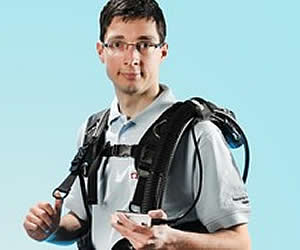
LAUSANNE, Switzerland -- The Suba system aims to become to diving what the automatic pilot is to flying. Developed by a student from EPFL, it will be released to the market by his start-up company: Pandora Underwater Equipment, starting from April 2012.
When a diver loses control, it's time for Suba to take over. This system connects the diver's stabilizer jacket to an 'intelligent' wristband. Thus, the jacket inflation/deflation system controlling the underwater explorer's buoyancy works automatically in the case of a problem. This ingenious device was developed by David Bonzon, micro technology student at EPFL, and will be released for sale from the month of April.
About 450 diving accidents are annually recorded in France, of which three quarters are due to decompression blunders, according to a survey carried out by the medical and national prevention commission of the Fédération Française d'Etude et des Sports Sous-Marins. This results in an average accident rate of one per 755 divers. At first, the distribution of this novel equipment will be targeting diving schools so that instructors can monitor and reassure beginners. "If someone panics, she or he is not capable of deciding whether to inject air into or to expel it out of the jacket, which is the moment when the device detects the irregularity and automatically takes care of managing the diver's decompression stops," David explains. It also allows to pre-set parameters such as the duration or depth level of diving.
David, just enrolled at EPFL, developed the system connecting the jacket to the device with his cousin Guillaume Raudel, automation engineer. It consists of an electromechanical system integrating solenoid valves and a control board. They have just applied for a patent.
Christophe Glez, professional diver and current COO of the start-up company, was the one to realize the necessity of finding a solution to the disorientation a diver can experience during ascent. After various tests in the family garage and later in the lake, Suba was born. Certain of the interest their device was to arouse in the market, these youngsters started to request financial aid from foundations supporting young companies. They finally obtained contributions from Venture Kick in 2011.
Further to taking Venture Lab courses and to exchanging discussions with established professionals like Christopher Webb, now CEO of the young enterprise, they have grown to be respected entrepreneurs. David is currently completing his master's degree in the United States and intends to invest himself in the start-up on a full time basis upon his return. The young company's office is based in the "Garage", famous incubator of EPFL businesses, and it currently employs four people, of whom two work full time.
Views expressed in this article do not necessarily reflect those of UnderwaterTimes.com, its staff or its advertisers.
Reader Comments
15 people have commented so far.We would need to hear a lot more about the actual functions and computer systems of this unit. A kneejerk reaction would be there is no way in hell I would want a mechanical and computerised combo in charge of my buoyancy that is, in part, also defined by my breathing and lung volume. Also we would need a lot more info on computer algorithms, pressure gradients and conservancy factor before deciding who is more qualified, me or it, to decide on appropriate deco times and depths (" David explains. It also allows to pre-set parameters such as the duration or depth level of diving"). Looking at it basic functions it seems to dumb down diving to a point where you might have to question if people using it actually belong in the water.
comment# 1 - Lee Butler · Philippines · Mar 14, 2012 @ 6:12am
France is home to the father of SCUBA, and patron saint of all divers, Jacques Yves Cousteau. All divers owe him a debt of gratitude, not only for his inventions, but for inspiring deep respect for and interest in diving. Having said that, I must agree with Lee Butler in terms of 'belonging' in a hazardous underwater situation, meaning technical diving or diving so deep and so long that ones life is endangered if decompression is messed up; In other words, dive within the NDL limits! My brother and I dive the deep submarine canyon in Monterey and Carmel 150x a year, but stay short minutes, then ascend along the (sub) terrain all the way back to the shallows. Putting a noob into a straight deco dive is reckless!
comment# 2 - Monterino · Campbell (Silicon Valley, also near Monterey) Cali · Mar 15, 2012 @ 7:37am
To Lee, I've been an active diver (former Navy) for 52 years and though I still love to dive I regularly observe divers who seem to have little more than a "resort course". On almost every dive vacation I've taken, there has been a serious accident, usually involving said divers. This includes dives in Cozumel, Curracao, California, Idaho, and Bonaire. If this unit can assist these minimally qualified "tourists" to survive, (especially if, say the divemaster could preset their max depth pre-dive) it certainly seems like something to be pursued.
comment# 3 - divesail · Eureka USA · Mar 15, 2012 @ 2:55pm
Hurray for these young entrepeneurs. Hope they make it big, and hope they make a ton of money. I know that I'll get one of these SUBA gadgets as soon as they are for sale here in the good U.S.A.
comment# 4 - Emilio Marcos · U.S.A. · Mar 15, 2012 @ 3:22pm
as a former dive instructor and avid diver, i find this of interest..i have taught in the far east and in the u.s. I have seen the dive industry grow and feel this would help out new divers. as dive computers and nitrox became more in use it changed the diving community and adapted by training agencies, so will this.I look for further development on suba.will this be a part of the training requirements for new divers attending dive training?
comment# 5 - michael cuesta · panama city fla,usa · Mar 15, 2012 @ 7:13pm
Although I applaud the idea on paper, I don't know if I would be willing to bet my life on a computer to save me in a deco accident. I also don't think it is wise to be a dive operator and rely on these BCD's to ensure my customers' safety. I think operators should ensure that Instructors and Dive Masters prevent these accidents to begin with. Further, divers should be properly certified and checked out before diving. Thirdly, as mentioned above, divers shouldn't dive at depths that require a deco stop (other than a mandatory buddy bar stop)unless they are, again, properly certified and checked out, and diving with a buddy they trust. Finally, the dive operator should maintain a low student to instructor/dive master ratio. That might cut into profits, but just defending yourself in court against a seriously hurt customer who sues you will cost a lot more money and loss of reputation than limiting student to staff ratios will. There shouldn't be a problem meeting these standards, unless you are a fly by night company. In that case, you shouldn't be in the business to begin with. Despite rumors to the contrary, PADI 5 star businesses must meet stringent standards. People should dive with them, or a similarly qualified operator, not someone else. (No, I dont work for PADI.)Naturally, all bets are off if you dive on your own. Then a SUBA might be warranted, but if you dive your tables, observe standards, properly maintain your equipment, etc., it shouldn't be an issue.
comment# 6 - dnm · san clemente ca · Mar 15, 2012 @ 8:42pm
AS A ADVANCE INSTRUCTOR, I WOULD SAY THIS BC FOR ADVANCE DIVERS ONLY! NEW DIVERS NEED TO CONTROL THEIR BC'S TO UNDERSTAND AND LEARN THE EFFECTS OF BUOYANCY! HOW EVER WE LIVE IN A WORLD THAT IF YOU'VE GOT THE MONEY YOU CAN HAVE IT. I STRONGLY ADVISE THIS EQUIPMENT SOUND REQUIRE AN COURSE IN ITS USE. NEVER THE LESS THIS IS A FANTASTIC ADVANCE IN DIVE EQUIPMENT CONGRATS TO THESE GENTLEMEN AND I HOPE THEY DO WELL. PLEASE REMENBER FOLKS THIS IS TEC DIVING NOT REC DIVING AND SHOULD BE TREATED AS SUCH. AS FORREST WOULD SAY "STUPID IS WHAT STUPID DOES LT DAN"
comment# 7 - ROY NAISBITT · CLEARWATER FL ,USA · Mar 15, 2012 @ 8:50pm
Apparently Nitrogen Narcosis can cause you to ignore the fact that your caps lock is on and other assorted punctuation issues.
comment# 8 - George Peterson · Radcliff, KY, USA · Mar 16, 2012 @ 6:45am
As a recreational diver, I can only echo the sentiments above. I've watched other novice divers push their limits - this endangers both themselves and their dive partners. As much as I'd love to do some deep dives/technical dives, I know my limits. If the profile isn't something I'm comfortable with, I arrange to snorkel instead. I would rather sit on board and relax than risk my life, my dive partner's or any rescue staff by diving beyond my limits. Like so many other safety-intensive sports, you MUST know the basics AND your skill set before tackling the next challenge. Gear like this should be issued only after you pass and maintain certification or tests.
comment# 9 - Linda Bates · Providence, RI · Mar 16, 2012 @ 6:49am
Congratulations to these gentlemen on their success. Having said that I will not use their product I believe that while it might help "Resort divers" it is not somthing that a serious diver will use. Its akin to putting training wheels on a Harly-Davidson. If your serious and want to take pride in what you do, you dont want to brag that a computer took you along for a ride. It is no substitute for proper training and experiance that only comes from actualy diving.
comment# 10 - Will · Waterville USA · Mar 16, 2012 @ 8:45am
I don't see how this would be useful for tec divers as tec decompression algorithms are customized for each dive based on the dive plan and the gas mixes. So unless the internal computer is a fully functioning tec computer that can have the customized profile entered, it seems risky. It also seems risky on the tec front as a single point of failure. It *might* make sense for recreational divers, however even there I see risks. In an out of air emergency I might need to exceed the normal rates of ascent if the alternative is drown. I am an active scuba instructor, and part of the learning process for students is to learn how to manage their buoyancy, I don't want to take that away from them, otherwise they will never become good divers. I would have lots of questions about reliability. If divers no longer learn to control their buoyancy and trust this device instead, what happens when the device fails?
comment# 11 - Sue · Raleigh USA · Mar 16, 2012 @ 11:23am
As an OLD instructor, #4786 OWSI, I have always started my students using the oral inflation of their BCs. Not only does this show them how little air it takes to establish bouyancy, it also gets them used to removing and replacing their regulator under controled conditions. After they get the hang of using a BCD then hook up the auto inflate they are less likely to lay on the button. Teach the basics, and you and your students will benefit.
comment# 12 - Ray Davies · Iowa City,Iowa,USA · Mar 16, 2012 @ 12:15pm
We are talking about a great advance in computerized safety diving, but gentlemen I must agreed with some of your comments that this type of technologies should be for advance divers only. There's always situations in which your life might depends on a rapid ascend or else and here in the Caribbean you should always expect the unexpected. Keep On Diving !!!
comment# 13 - Angel Valencia · Arecibo, Puerto Rico USA · Mar 16, 2012 @ 1:27pm
While many seem somewhat worried about the risks of such a device, similar devices carry you to the world's dive sites aboard every commercial airplane in the world. Ascent and descent rates, speed, and altitude are held within mere feet. This will do the same.
comment# 14 - Roger · San Diego, CA USA · Mar 17, 2012 @ 8:37pm
There is no gadget, device or piece of equipment that can be a suitable substitute for good, thorough training. However, with that said, I'm sure there will be a market for this new device. Someone in a previous message mentioned that this device should be for advanced divers only because "NEW DIVERS NEED TO CONTROL THEIR BC'S TO UNDERSTAND AND LEARN THE EFFECTS OF BUOYANCY!" While I do agree, if you see the trends, this is not the thinking in today's training environment. New divers also need to learn the dive tables. But training is moving to "computer only" courses that teach the student to dive with computers but does not teach them what the computer is calculating. They just look at "random" numbers on the display without really knowing what the numbers represent physiologically. Bottom line for me...this is a new advancement in diving that will find a niche somewhere.
comment# 15 - Carlos · Honolulu, HI · Mar 19, 2012 @ 11:11am