
Subscription Services: Subscribe | Change | Unsubscribe | RSS
Advertising Media Kit: Introduction | Stats/Demographics | Rates | Testimonial | Contact
Miscellaneous: Reference Desk | Sitemap
Related Reading
NOAA: Use Of Lethal Force To Stop Protected Sea Lions From Eating Protected Salmon Has Been Approved
email to a friend email print this print      Bookmark and Share   RSS 2.0 feed

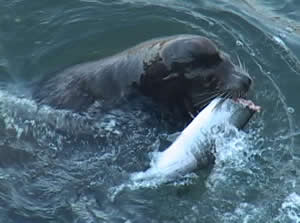
SILVER SPRING, Maryland -- NOAA's Fisheries Service said today it was authorizing Idaho, Oregon and Washington to permanently remove the specific California sea lions eating the imperiled salmon and steelhead that congregate below Bonneville Dam as they head up the Columbia River to spawn. The authorization becomes effective on March 20 and stays in effect until the end of May 2016.

The agency has authorized the states to remove up to 92 animals annually, but estimates that far fewer, about 25 to 30, will be taken each year, given the conditions in the authorization.

Under the Marine Mammal Protection Act, states can request permission to kill individually identifiable California sea lions or seals that are having a "significant negative impact" on at-risk salmon and steelhead, and NOAA's Fisheries Service can grant that permission if certain legal standards are met.

State and federal biologists estimate that California sea lions have eaten between one-and-a-half and four percent of returning adult salmon at Bonneville Dam each year during the past eight years. This estimate is based on expert observations by federally trained biologists. Most of the fish eaten were spring Chinook or steelhead, and almost a third of the salmon and steelhead eaten by the sea lions are from stocks listed under the Endangered Species Act. Predation peaked in 2010, when about 6,000 adult salmon were eaten. Last year, about 3,600, or just over one and a half percent of the returning adult population, were eaten.

Under the authorization provided today, the states may euthanize individually identified California sea lions if no permanent holding facility, typically aquariums, for them can be found.

The agency's authorization responds to a request last summer from the three states to "lethally remove" predatory sea lions under a provision of the Marine Mammal Protection Act. Today's action will allow the states to target only individual sea lions that continue to eat salmon after deterrence methods have proven unsuccessful.

The current estimated West Coast population of California sea lions is almost 300,000, and biologists estimate that more than 9,000 animals could be removed from that population through human-caused actions such as ship strikes or entanglement in fishing nets without harming the species. In a typical year, about 430 California sea lions die from human-caused actions.

For the past several years, NOAA's Fisheries Service and other state, tribal and federal agencies have employed a wide range of deterrence methods, including using firecrackers and rubber buckshot, to discourage the sea lions from foraging at the dam. These efforts have been largely unsuccessful.

The agency first authorized the states to euthanize California sea lions starting in 2008. The program was suspended in 2010 as a result of a court order. To date, the states have trapped and removed 38 California sea lions under various agency authorizations. Ten were relocated to captive display facilities and 28 were euthanized.

Views expressed in this article do not necessarily reflect those of UnderwaterTimes.com, its staff or its advertisers.

Reader Comments

9 people have commented so far. cloud add your comment

I think harming the California Seals who were here just as long as the salmon is nuts. These are protected animals. Soon the zoos may as well close because the human race seems to care less about any of the animals that are endangered. Why can't we just leave them alone instead of encroching on each others domain.
   comment# 1   - Mary · Sturgeon Bay, USA · Mar 16, 2012 @ 9:47pm

Was it the seals that caused the salmon to wind up an endangered species? NOAA is sadly, not immune from the halls of politics and soft money.
   comment# 2   - peter paul · spring grove, va · Mar 17, 2012 @ 11:37am

the ones that enviros think have right to get right up in the fish ladders and into the public viewing windows and in the salmon jam right below the dam are the problom alot of these big bulls are 1000 lbs.they start only eating the eggs out of female salmon after geting full .they get very choosy when there in mass consuntrions of spring chinook and they kill more than they eat i have seen them do this day and night for weeks
   comment# 3   - gerald moorcroft · north bonneville indian camp/tribal friend · Mar 17, 2012 @ 3:18pm

It's too bad that the NOAA Fisheries guys don't look at the mouths of the Smith, Mad, Klamath, Mattole, and Eel Rivers. The sea lions lounge on the beaches until the tide brings in a new batch of salmon, then they go out and eat the bellies out of the females (for the roe) and the gutted fish sink to the crabs on the bottom. There are THOUSANDS of sea lions at the mouths of these California rivers. If the 100 Bonneville Dam lions eat 1-4% of the fish below the dam, what percentage do the 1,000's at the mouths of our rivers eat? When I was commercial fishing, I had to battle a sea lion for a salmon I'd hooked. I won that time, but the fish couldn't be sold with teeth marks down its side. The coastal Native Americans used to hunt the sea lions and use the meat and skins too, a practice I think should be allowed again. THEY knew that the sealions were eating their salmon and they DID something about it. without committees, and fact-finding studies and all the other quack-quack NOAA is using these days. You REALLY ought to see an aerial photo of the mouths of our rivers. That's why we don't have decent fish runs any more, the sea lions have no predators like they used to. Calif. DFG is setting up no-fish zones to help the resource, tell That to the sea lions. NOAA should enforce our 200 mile limit. We asked for PFMC in the 70's to do just that, what did we get? PFMC regulating US! Not the foreign boats with 1" mesh nets that take it ALL! Product of VietNam salmon? HAH!
   comment# 4   - DS Davis · Eureka, Humboldt County,Calif., USA · Mar 17, 2012 @ 3:58pm

I suppose the fact that humans have interfered and built dams that block the natural water flow and breeding grounds of these fish have nothing to do with this problem. If humans would stop altering wildlife habitats, this would not be a problem to begin with. What a mess people are making, and their answer is to kill whatever does not suit them, rather than take responsible actions. They may call it "euthanize", but it's still death of an unwilling victim that can not speak for itself.
   comment# 5   - Deborah · Hometown, FL · Mar 18, 2012 @ 5:46am

Its crazy how we think we can manage nature. We need to work with it and not continue trying to affect mother nature. The planet is not a farm to be controlled an manipulated. We are to exist within it. We continue to try an manipulate systems to our benefit instead of working with it. While I would say some countries are trying other countries just do not give a crap and will continue to destroy an ecosystem until it is destroyed.
   comment# 6   - Robert · Portland, USA · Mar 18, 2012 @ 9:02am

Kill them! I agree with DS. Well said!
   comment# 7   - Eric · Ferndale WA · Mar 20, 2012 @ 11:53am

It is a wonder that California still has any anadromous fish considering water diversions and poor water management. But we still do. The real problems are too many seals, not enough fish, and not enough cold river water when needed. Fish lose!
   comment# 8   - bob p · plymouth, ca · Mar 22, 2012 @ 3:53pm

We should use the California sea lion to help rid us of the Asian carp in the great lakes. They look like they are the animal for the job.
   comment# 9   - Mary · Rochester · Apr 1, 2012 @ 6:32am
Add your comment


characters left

*required field.
Note: Comments are posted if they are not abusive and are compliant with our Terms and Conditions. Comments with foul language will be deleted without exception.


bottom_left
bottom_right
Privacy Policy     © Copyright 2013 UnderwaterTimes.com. All rights reserved