
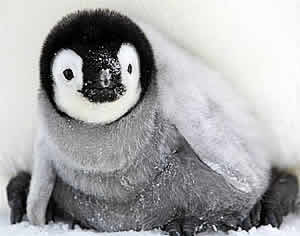
Satellite Trackers To Delve Into Diet Of Emperor Penguin Chicks; 'We Will Be Able To Record From Their Very First Dive'
Underwatertimes.com News Service
November 2, 2009 22:52 EST
KINGSTON, Tasmania -- With the help of satellite trackers, the foraging habits of emperor penguin chicks will be studied by Australian scientists this summer.
Researchers from the Australian Antarctic Division will fit tracking equipment to several chicks at the Amanda Bay Colony, near Davis station.
The trackers will provide real-time data on where the fledglings travel and how deep they dive.
Seabird ecologist, Dr Barbara Wienecke, said previous research has focused on the feeding behavior of adult birds.
"We know the adults can travel up to 140 km a day and dive to a depth of more than 500 metres in search of fish," Dr Wienecke said.
"What we don't know is how these amazing skills are developed, so by tracking the fledglings we will be able to record from their very first dive through to when they become highly-skilled predators."
The study will help scientists get a clearer picture of the emperors' foraging areas and where there could potentially be an overlap with commercial fishing fleets.
"If the top few meters of a particular area are fished out this could have a huge impact on the juvenile emperor penguins which may not have the ability to dive deeper for their food," she said.
Dr Wienecke will spend three months in Antarctica undertaking the research.
New Japanese Prime Minister Urged To Recall Whaling Fleet, 'Chart A New Course For 21st Century' -November 19, 2009 14:29 EST
Ocean Conservancy Welcomes Shark Conservation Act Introduction In The U.S. Senate -November 19, 2009 14:18 EST
Researchers: Oceans' Uptake Of Manmade Carbon Slowing; 'We Cannot Count On These Sinks Operating In The Future' -November 18, 2009 22:02 EST
Scientists Unravel Evolution Of Highly Toxic Box Jellyfish; Research Could Help Lead To Antivenoms And Treatments -November 18, 2009 21:55 EST
Sharks Under Threat As Environmental Change Bites Hard; 'Slow Growth And Low Reproductive Capacity' -November 17, 2009 22:12 EST
Billfish Angler Leads 'Expedition Great White' On National Geographic Channel; 'A Life-changing Moment' -November 16, 2009 20:59 EST
Scientists Ponder The Implications As Warmer Temperatures Bring More Wind On The World's Biggest Lake -November 15, 2009 16:25 EST
Sponges Recycle Carbon To Give Life To Coral Reefs; 'It Is Quite Dark And Technically Difficult To Work In The Cavities' -November 13, 2009 18:45 EST
Scientists Ponder: How Much Water Does The Ocean Have? -November 13, 2009 17:29 EST
WW II-era Japanese Attack Submarines Discovered Off Hawaii; Technology 'Far Ahead Of Its Time' -November 12, 2009 14:41 EST
Reader Comments
No comments have been submitted. Why not be the first to tell us your thoughts?