
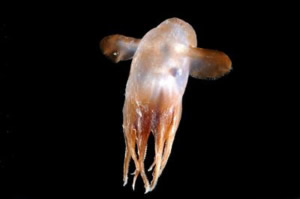
This unfamiliar Dumbo species collected by Census of Marine Life scientist may prove to be a new to science. Credit: David Shale, MAR-ECO
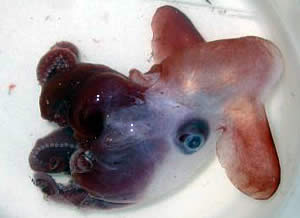
The nine known species of rare, primitive finned octopods are called “Dumbos” because their large flapping ear-like fins. Credit: Michael
Census of Marine Life scientists have inventoried an astonishing abundance, diversity and distribution of deep sea species that have never known sunlight - creatures that somehow manage a living in a frigid black world down to 5,000 meters (~3 miles) below the ocean waves.
Revealed via deep-towed cameras, sonar and other vanguard technologies, animals known to thrive in an eternal watery darkness now number 17,650, a diverse collection of species ranging from crabs to shrimp to worms. Most have adapted to diets based on meager droppings from the sunlit layer above, others to diets of bacteria that break down oil, sulfur and methane, the sunken bones of dead whales and other implausible foods.
Five of the Census' 14 field projects plumb the ocean beyond light, each dedicated to the study of life in progressively deeper realms - from the continental margins (COMARGE: Continental Margins Ecosystems) to the spine-like ridge running down the mid-Atlantic (MAR-ECO: Mid-Atlantic Ridge Ecosystem Project), the submerged mountains rising from the seafloor (CenSeam: Global Census of Marine Life on Seamounts), the muddy floor of ocean plains (CeDAMar: Census of Diversity of Abyssal Marine Life), and the vents, seeps, whale falls and chemically-driven ecosystems found on the margins of mid-ocean ridges and in the deepest ocean trenches (ChEss: Biogeography of Deep-Water Chemosynthetic Systems).
Edward Vanden Berghe, who manages OBIS (Ocean Biogeographic Information System), the Census' inventory of marine life observations, notes that, unsurprisingly, the number of records in the database falls off dramatically at deeper depths (see animation at http://coml.org/embargo/beyond-sunlight) - a function of the dearth of sampling done in the deep sea.
However, Dr. Vanden Berghe reports that OBIS today records 5,722 species for which all recorded observations are deeper than 1,000 meters (~.62 miles) and 17,650 species for which all recorded observations are deeper than 200 meters, the depth where darkness stops photosynthesis.
Scientists working on the deep-sea Census number 344 and span 34 nations.
By the time the 10-year Census concludes in October, 2010, the five deep-sea projects will have collectively fielded more than 210 expeditions, including the first ever MAR-ECO voyage in October-November this year, to explore the Mid-Atlantic Ridge south of the Equator, a scientific collaboration between Russia, Brazil, South Africa and Uruguay.
Each voyage is hugely expensive and challenged by often extreme ocean conditions and requirements that have kept the remotest reaches of Neptune's realm impenetrable until recently.
While the collective findings are still being analyzed for release as part of the final Census report to be released in London on October 4, 2010, scientists say patterns of the abundance, distribution and diversity of deep-sea life around the world are already apparent.
"Abundance is mostly a function of available food and decreases rapidly with depth," says Robert S. Carney of Louisiana State University, co-leader (with Myriam Sibuet of France) of the Census project COMARGE, studying life along the world's continental margins.
"The continental margins are where we find the transition from abundant food made by photosynthesis to darkened poverty. The transitions display the intriguing adaptations and survival strategies of amazing species," says Dr. Carney.
Abundance in the deep sea requires one or more of the following:
- Swift current, which increases an animal's chance of encountering food;
- Long-lived animals, populations of which grow numerous even on a meager diet;
- Abundant food in higher layers that either settles to the depths or to which deep animals can migrate;
- An alternative to photosynthesis of food, such as chemosynthetic production.
"In the bathy- and mesopelagic zones - the largest 3D deep-sea living space - animals either have to cope somehow with food scarcity or migrate long distances up to find food," says MAR-ECO project leader Odd Aksel Bergstad of University of Bergen. "Because it provides an oasis of topographical relief in the center of the ocean, we found a high concentration of animals on the Mid-Atlantic Ridge."
"Distribution is pretty straightforward for animals in the deep sea," says Dr. Carney. "The composition of faunal populations changes with depth, likely a consequence of physiology, ecology and the suitability of seafloor habitat condition for certain animals."
"Diversity is harder to understand. Although the mud on the deep sea floor appears monotonous and poor in food, that monotonous mud has a maximum of species diversity on the lower continental margin. To survive in the deep, animals must find and exploit meager or novel resources, and their great diversity in the deep reflects how many ways there are to adapt."
Meeting an unfamiliar Dumbo, and other tales from the deep
Specific discoveries, some beautiful and all pushing back the frontiers of the unknown, illustrate the results of voyages by the five Census projects exploring the dark deep sea.
On two 2009 voyages to the Mid-Atlantic Ridge by MAR-ECO explorers:
- At 2,000 to 2,500 meters (~1.25-1.5 miles): A bizarre, elongated orange animal identified as Neocyema -- only the fifth specimen of the fish ever caught and never before on the Mid-Atlantic Ridge;
- At 1,700 to 4,300 meters (~1-1.9 miles): Coryphaenoides brevibarbis, with tiny bones in its ear, known as otoliths, that have growth bands countable like tree rings to reveal the fish's age. Comparison of age with size shows its growth rate and thus the amount of food in the neighborhood. Called the rat-tail, the fish lives on crustaceans it catches just above the seafloor.
- At 1,000 to 3,000 meters (~.6-1.9 miles): NOAA researchers led by Mike Vecchione of the Smithsonian Institution collected a very large specimen of a rare, primitive animal known as cirrate or finned octopod, commonly called "Dumbos" because they flap a pair of large ear-like fins to swim, akin to the cartoon flying elephant. The jumbo Dumbo netted by Census explorers was estimated to be nearly two meters (~6 feet) long and, at 6 kg (~13 pounds), the largest of only a few specimens of the species ever obtained. Altogether, nine species of gelatinous "Dumbos" were collected on the Mid-Atlantic Ridge, including one that may be new to science. Scientists were surprised to find such a plentiful and diverse assemblage of these animals, which rank among the largest in the deep sea.
- At 1,000 meters (~.6 miles): an "indescribable" catch of "invertebrates of all colors, including corals, sea cucumbers and sea urchins. It's hard to believe that such exuberance of life exists a kilometer deep into the ocean."
On a 2007 voyage in the Gulf of Mexico by COMARGE explorers:
- At 990 meters (~.6 miles): A solitary tubeworm (formally known as Lamellibrachia), in what looked like ordinary surroundings. After a robotic arm lifted the worm from a hole in the Gulf floor, however, crude oil streamed from both the animal and the open hole. The "wildcat" tubeworm had hit a gusher and was dining on chemicals from decomposing oil. See Video News Release: http://coml.org/embargo/beyond-sunlight;
- At 2,750 meters (~1.7 miles) in the Northern Gulf of Mexico: an odd transparent sea cucumber, Enypniastes, was videorecorded creeping forward on its many tentacles at about 2 cm (~.8 inches) per minute while sweeping detritus-rich sediment into its mouth. At the end, it blooms into a startling curved shape and swims away to find another meal
On a just-ended 36-day voyage to the Cayman Trough in the Caribbean, the setting of the 1989, fictional film The Abyss, ChEss explorers were poised to explore the deepest hot-springs on Earth: only to be thwarted by the arrival of tropical storm Ida. Neverthless:
- Working at depths of greater than 4,000 meters (~2.5 miles): Chris German of Woods Hole Oceanographic Institution, ChEss co-chair, and colleagues from the US, UK and Japan found evidence for chemically enriched plumes in the water column signaling the presence of seafloor hot vents hundreds of meters deeper still. Funded by NASA's Astrobiology program, the team used WHOI's new hybrid robotic vehicle, Nereus, first as a free-swimming autonomous underwater vehicle (AUV) and then as a tethered, battery powered remotely operated vehicle (ROV) to track the plume to its source and begin to investigate the seafloor. Bad weather forced the team to break off only hundreds of meters from their target - a search that will now be resumed by ChEss using the UK's AUV Autosub 6000 and ROV Isis in 2010.
On a 2009 voyage to a range of New Zealand seamounts, a CenSeam team found:
- At 1,000 meters (~.6 miles) and below: abundant vibrant coral gardens in an area of seamounts eerily nicknamed "the Graveyard," where the speed of currents provides ideal habitat for these animals that feed on suspended food. The scientists, who also explored the nearby Andes seamounts, discovered diverse communities living amid the cold water corals, including invertebrates like sponges and seastars and a species of worm that lives within the branches of bamboo corals (Family Isididae), modifying how the corals grow.
On a 2009 voyage to the Antarctic and Southern Ocean a CeDAMar team trapped deep-sea life:
- At about 500 meters (~.3 miles): the Antarctic's first recorded whalebone-eating worm, Osedax. Seventeen species had been reported on other fallen whales in such places as the shallow northeast Atlantic off Sweden, the northeast Pacific off California and the northwest Pacific off Japan. CeDAMar scientists attached whalebone snacks to two vehicles and parked them 550 and 630 meters (~.34-.39 meters) deep near Smith Island near the West Antarctic Peninsula. When they raised the parked vehicles after 14 months, they found the same creatures in the Southern and Antarctic Oceans. Analyzing the populations crowded onto the parked vehicles they found new species of the whalebone-eating genus Osedax. A mat of chemosynthetic microbial fauna and the small marine worm Ophryotrocha that eats bacterial mats covered the raised vehicles.
Diversity and abundance in mud: the living skin of the abyss
On the abyssal floor, the deep mud contains biodiversity that escapes detection by video and photography since most of the animals are only a few millimeters in size and hide among the sediment particles.
"Some scientists have likened deep mud's biodiversity to that of tropical forests. In college I was taught that high biodiversity is a function of habitat diversity - many nooks and crannies. It is, however, hard to imagine anything as monotonous, nook-less and cranny-less as deep-sea mud," says Dr. Carney.
Sometimes, the vast majority of creatures collected in mud from the abyssal plains are new to science, says CeDAMar expert David Billett of UK's National Oceanography Centre.
Of some 680 specimens of copepods collected on a recent CeDAMar cruise (DIVA 2) to the southeastern Atlantic, for example, only seven could be identified; 99 percent were new to science. And among hundreds of species of macrofauna (animals about the size of an earthworm) collected in different areas, 50 to 85 percent were unrecognized.
"The abyssal fauna is so rich in species diversity and so poorly described that collecting a known species is an anomaly," says Dr. Billett. "Describing for the first time all the different species in any coffee cup-sized sample of deep-sea sediment is a daunting challenge."
Far rarer than new species in the mud is the capture of a new species of sea cucumber, and rarer still a new genus. However, Dr. Billett and colleagues from the National Oceanography Centre and the Shirshov Institute, Moscow, accomplished this feat this year around the Crozet Islands after steaming for a grueling six days south from South Africa.
One of the new sea cucumbers was yellowish-green, a rare find as virtually all others found in the global seas are whitish grey or purple.
However, what startled researchers most was finding that the most abundant sea cucumber around the Crozet Islands - thousands of specimens at abyssal depths - was a species never seen anywhere else before, now dubbed Peniagone crozeti.
"The distribution of species in the deep sea is full of mysteries," says Dr. Billett. "In addition to the boundaries caused by underwater topography, ridges and seamounts, there are unseen, and as yet unexplained, walls and barriers that determine supplies of food and define the provinces of species in the deep sea."
"There is both a great lack of information about the 'abyss' and substantial misinformation," says Dr. Carney.
"Many species live there. However, the abyss has long been viewed as a desert. Worse, it was viewed as a wasteland where few to no environmental impacts could be of any concern. 'Mine it, drill it, dispose into it, or fish it - what could possibly be impacted? And, if there is an impact, the abyss is vast and best yet, hidden from sight.'
"Census of Marine Life deep realm scientists see and are concerned."
Expensive, dangerous work
"The deep sea is the Earth's largest continuous ecosystem and largest habitat for life. It is also the least studied," says Dr. German.
Sampling at great depths depends on high tech instruments (such as remotely operated vehicles (ROVs), autonomous underwater vehicles (AUVs), and submarines) or "traditional" equipment (trawls, cores, dredges) that need several kilometers of cable to reach the seabed. For example, 12 km (~7.5 miles) of cable was needed to trawl recently down to 4,800 meters (~ 3 miles) depth on the Porcupine Abyssal Plain in the Northeast Atlantic.
Earlier this year, CenSeam scientists aboard New Zealand-based Research Vessel Tangaroa underlined the grueling nature of the challenge of obtaining samples, maps and unprecedented underwater footage of the Graveyard and the Andes seamounts in the South Pacific.
The work was performed with a Deep-Towed Imaging System (DTIS), a technology developed and refined by growing experience over rugged, unfamiliar seamounts and ridges, yielding steadily better results.
Says Mireille Consalvey of the New Zealand National Institute of Water and Atmospheric Research, CenSeam project manager, "Every deployment is a trip into the unknown, with often seasick scientists struggling to work amid high winds and 10 meter swells."
"It can be a tough environment down there. I recall once the abject fear when our video imaging system snagged for 40 minutes on a rock face -- the slow, scary process of recovering it, and the shared worry that our valued recording equipment would arrive at the surface battered and bent. Thankfully, the recorder survived the ordeal better than many of us and yielded brilliant new footage of this remote realm."
One final note about life in the abyss: not all intruders from the lighted world are ROVs or submarines. A southern elephant seal tagged by Census project TOPP recently dove down 2,388 meters (~1.5 miles) from the surface. At that depth, water pressure is roughly equal to 240 times the air pressure at sea level. The human eardrum can rupture at 10 meters.
Census of Marine Life Started in the year 2000, the Census of Marine Life is an international science research program uniting thousands of researchers worldwide with the goal of assessing and explaining the diversity, distribution and abundance of marine life. It is supported by private sources and government agencies the world over, listed online at www.coml.org/support.